What to do when ACA Marketplace stops being affordable
Your premium went up, the subsidy was recalculated, but the cancel button is not the only option. We break down what a single episode without coverage costs and what to do when paying the old way no longer works.


Your premium went up, and it isn't a Marketplace error
The insurance bills this year came out different. Some people saw the premium rise by a third, some saw it double, and some, for the first time in years, saw the full price of a plan in their account without a single cent of subsidy.
If your payment went up, it almost certainly isn't about your situation. The rules changed, and they changed in three places at once. The main one: the enhanced subsidies in place since 2021 have ended. They expired, and the math went back to the base formula, which for a household with average income means a return to what the numbers were five years ago.
Second, the way income and the affordability threshold are calculated has changed, and some people no longer qualify for a subsidy on the same earnings. Third, automatic re-enrollment has been removed: eligibility now has to be confirmed actively, and anyone who did nothing in the fall got a full-price bill in January.
Work out which of the three reasons is yours. It matters: the third one you can fix in a single evening, while the first two you have to accept as a given and work with.
And here is the question most people who opened the cancel button have no answer to. All right, what happens next? Not in terms of penalties — the federal penalty for going uninsured has been gone for years. In terms of money. What does staying without coverage actually cost.
What a single episode without coverage costs
This question is better answered with numbers than with words.
| Service | Uninsured | With an ACA plan (Silver) |
|---|---|---|
| Everyday care | ||
| Primary care visit | $150 – $300 | $40 copay, before the deductible |
| Specialist visit | $250 – $500 | $80 copay, before the deductible |
| Diagnostics | ||
| MRI or CT | $400 – $3,500 | 40% after the deductible |
| Emergency | ||
| Ambulance ride | $940 – $1,400 | 40% after the deductible |
| Emergency room | $1,500 – $3,000 | 40% after the deductible |
| Hospital and surgery | ||
| A day in the hospital | from $3,000 per day | 40% after the deductible |
| Appendix removal | $15,000 – $40,000 | 40% after the deductible |
| Knee replacement | $30,000 – $50,000 | 40% after the deductible |
| Your maximum out-of-pocket for the year | No limit | $8,900 plan limit |
On the left is a typical uninsured bill: the amounts vary a lot by state and clinic, so they are shown as a range. On the right is a standard Silver plan on the ACA Marketplace in 2026: a $6,000 deductible, a per-visit copay charged before the deductible, and the rest at 40% of the network price — which is lower than the uninsured bill. The out-of-pocket limit set by law for 2026 is $10,600 per person. Sources: CMS (2026 standard plans), HHS Notice of Benefit and Payment Parameters, KFF, AHRQ HCUP, FAIR Health.
Now compare that with the amount you are planning to save. The annual premium for a plan is, say, six or eight thousand dollars. An unpleasant figure, but it has one property: it is known in advance and it does not change. You can build a budget around it.
The numbers in the table above do not have that property. Appendicitis does not schedule itself, and a fracture does not ask whether this was a good year. By canceling coverage, a person trades a predictable expense for an unpredictable one — and that, not the amount itself, is the heart of the decision.
It gets easier from here. You will not have to go completely unprotected in any of the scenarios, and the next two sections are exactly about what you can do. We will start with the most obvious and the most underrated option.
Before you cancel: three ways to pay less
Before you give up your main plan, it is worth spending an hour to check three things. Sometimes that is enough to settle the question.
- Recheck the subsidy. The most common reason money is lost is an error in the application: overstated income, the wrong tax household, a spouse or an adult child left off the return.
- Move down a metal level. The premium difference between levels can be substantial. But check cost-sharing reductions: at a certain income a Silver plan gives copay discounts that a Bronze plan does not.
- Look at off-exchange plans. Off-exchange coverage is full major medical insurance straight from the carrier. The subsidy does not apply to it, but if you are not getting the subsidy anyway, there is nothing to lose.


And now the trap this section was written for.
The cheapest Bronze plan lowers the premium — but its deductible easily reaches nine thousand dollars per person.

The problem is not that insurance is expensive. The problem is that cheap insurance does not pay — and making it cheaper does not solve the situation, it hides it. This is exactly where the logic a person started with breaks down. So you need something that pays right away.
Insurance that pays from day one
A tool like that exists, and it works differently from everything above. Regular insurance calculates a percentage of the bill, and you learn the total after the fact. A fixed-benefit plan works the other way around: for every covered event there is a specific amount, known in advance. There is no deductible, no copays, and no coinsurance. The only thing you pay is the monthly premium.
The benefit is fixed and does not depend on the size of the bill. Below are the amounts the plan pays for each service, either straight to the provider or to you.
The plan is not a replacement for health insurance, and it does not cover pre-existing conditions in the first year — but it can bring your medical costs down.

A few reference points. A primary care visit runs from $80 to $150 depending on the plan level. An MRI or CT is $400 to $1,000. A day in the hospital is $2,000 to $5,000, the same for a day in intensive care, plus an extra benefit for the first day. Appendix removal is $500 to $1,000, spinal surgery up to $5,000. The plan's annual maximum is up to two million dollars per person.
A note on the network. The plan does not restrict your choice of doctor: the benefit is fixed and does not depend on where you go. But when you use the UnitedHealthcare Choice Plus network, a network discount on the bill itself is added on top of the benefit — about 58% on average. Example: a $1,090 bill for a test, an $852 network discount, a $150 plan benefit, and your cost is $88.
Everything else is worked out in advance. You know the amount before the bill arrives.
Two scenarios, and both are covered
Almost every reader of this article is in one of two situations.
You keep your main plan, but you cannot use it because of the deductible. In that case fixed benefits close exactly the gap that makes the plan feel useless: the money goes toward the very thousands you have to pay before the insurance kicks in.
You can no longer pay for your main plan. Fixed benefits will not replace it — but they will turn complete uncertainty into predictable amounts starting at $124 a month.
We worked out roughly what each plan level would cost you if you actually use it. The calculation is approximate, because the exact amounts depend on many factors.
The three levels differ only in the size of the benefits and the limits; the set of covered events is the same.
Before you calculate any further, check one thing. The plan operates in 35 states, and the available levels and benefit amounts differ from state to state.
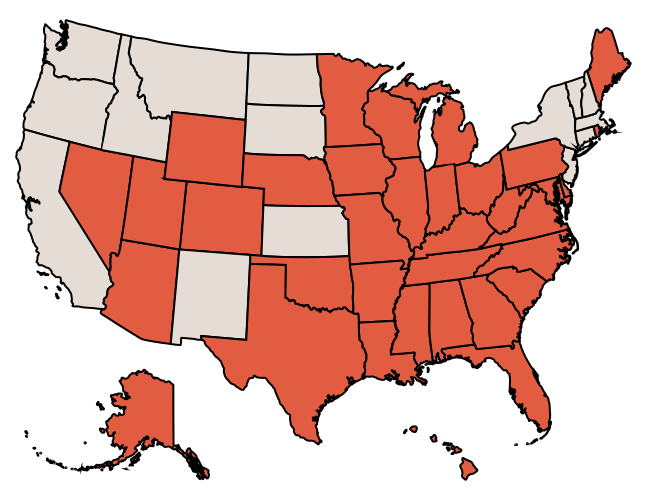
One last thing, if you have decided to put the question off until November. There is no need to wait: fixed benefits are not tied to the open enrollment period and do not require a qualifying event — you can enroll on any day of the year. There is nothing to wait for.
A one-on-one consultation
If you have read this far, you are seriously considering the Health ProtectorGuard plan. You can get to know it even better on the product page, or in a one-on-one consultation where a licensed insurance agent will answer every question you have.
The call takes about fifteen minutes, it is free, and it commits you to nothing.
Legal information
This material is for information only and is not legal, tax, or financial advice. Eligibility for a subsidy, the size of the premium, and the plans available to you depend on your income, your state of residence, and your immigration status. ACA Marketplace rules changed repeatedly in 2026–2027. The date this material was last updated is shown at the top of the page.
Health ProtectorGuard is supplemental fixed-benefit insurance (UnitedHealthcare). It is not minimum essential coverage and not a replacement for major medical insurance. Amounts, limits, and exclusions vary by state.
Averon Insurance (Sergei Nesterov, LLC) is a licensed insurance broker. Texas resident license, NPN: 22255483. Full list of licenses.