HEALTH PROTECTORGUARD
Financial support when you need it most
A set amount for every visit, scan, surgery, and day in the hospital. Not a percentage of the bill, but a specific amount paid directly to you

Select 2000
A good fit for
For people who rarely see a doctor and want to cover the risk of one major hospital stay.
Strong points
Coverage for a hospital stay of any length at the lowest premium.
$124 / mo
Preferred 4000
A good fit for
For families with a high deductible who need the benefit to cover it in full.
Strong points
Twice the benefit for every day in the hospital, plus broader support for surgery.
$195 / mo
Premier 5000
A good fit for
For people who see a doctor regularly and want benefits beyond hospital stays.
Strong points
The highest benefits across the board, from the ER to surgery, plus generous outpatient coverage.
$270 / mo
The monthly cost is approximate, calculated as an average for one person across age groups living in the state of Texas. The final price will vary by state, age, gender, and other factors.
58%
AVERAGE NETWORK DISCOUNT
The average discount was calculated by UnitedHealthcare using 2023 data. Your actual savings depend on the provider and the type of service.
AN EXAMPLE
Why the network matters so much
Using the network brings the cost of care down substantially. You can see any doctor you like, but the plan pays off most inside the network
$1,090
BILL FOR THE TEST
$852
NETWORK DISCOUNT
$150
PLAN BENEFIT
$88
YOUR COST
WHAT MAKES UP THE $1,090
Example taken from UnitedHealthcare materials. The actual cost of a service and the size of the network discount depend on your region and provider.
COST
What the plan costs when you actually use it
We worked out roughly what each plan level would cost you over a year of real use. The figures are approximate: exact amounts depend on many factors.
A year without incident: an annual checkup, three doctor visits, two scans, and six prescriptions.
Premier 5000
$3,649
$2,779
Preferred 4000
$2,749
$2,054
Select 2000
$1,949
$1,449
The same, plus specialist visits, an MRI, and minor outpatient surgery with no overnight stay.
Premier 5000
$8,249
$699
Preferred 4000
$7,349
$2,949
Select 2000
$6,549
$3,859
An emergency room visit, surgery, and six nights in the hospital, two of them in intensive care. Twelve doctor visits and eighteen prescriptions.
Premier 5000
$40,369
$13,741
Preferred 4000
$39,469
$3,221
Select 2000
$38,669
$15,479
The calculation includes annual plan premiums and bills at UnitedHealthcare network rates. Your premium depends on state, age, gender, and tobacco use — an agent will quote the exact amount. Benefits are counted service by service: a surplus on one does not offset a shortfall on another, it comes back to you.
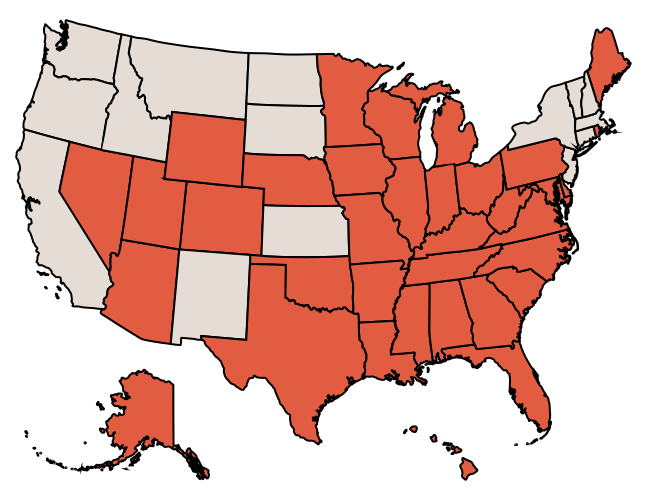
WHERE IT IS AVAILABLE
The plan is available in most states
Plan levels and benefit amounts vary from state to state
$2M
ANNUAL MAXIMUM
35
STATES
$5M
LIFETIME MAXIMUM
STEP BY STEP
How does it work?
The process is the same for all three plans. Only the benefit amounts differ
-
STEP 01
You seek medical care.
-
STEP 02
You receive the treatment you need.
-
STEP 03
If the service is covered by the plan, the insurer pays the amount set out in the contract.
-
STEP 04
If you use the UnitedHealthcare Choice Plus network, the cost of care drops further thanks to network discounts.
SERVICES AND BENEFITS
How much each plan pays
The benefit is fixed and does not depend on the size of the bill. Below are the amounts the plan pays for each service, either straight to the provider or to you
Select 2000
Lowest entry price
Preferred 4000
Balance of price and coverage
Premier 5000
Highest benefits
EVERYDAY CARE
Prescriptions
$40 12 prescriptions per year $60 12 prescriptions per year $60 20 prescriptions per yearDIAGNOSTICS
HOSPITAL
SURGERY
PLAN
A FIXED AMOUNT
The plan pays the stated amount regardless of the bill. If the benefit turns out to be larger than the bill, the difference goes to you.
FROM THE SECOND YEAR ON
Benefits for a day in the hospital double — but only for injury, not illness. The increase happens once.
WHAT IS NOT COVERED
For the first 12 months, any condition you had before enrolling. Also pregnancy, mental health care, and dental care.
Source: UnitedHealthcare Health ProtectorGuard brochure, form 52001-G-0226, policy HPG3-GRI, 2026 data. Amounts, limits, and exclusions may vary by state. This is supplemental insurance with limited benefits — it does not replace major medical coverage.
ONE ON ONE
Ask your question in a one-on-one consultation
Didn’t find the answer you were looking for and still want to get to the bottom of it? We will walk you through it one on one
 Company
AVERON INSURANCE
Company
AVERON INSURANCE
 Insurance agent
Sergey Nesterov
Insurance agent
Sergey Nesterov
What do people ask most often on the first call?
The question I hear most is “where’s the catch.” There is no catch, there are limits, and I go over them with every client: fixed amounts instead of a percentage of the bill, no coverage for pre-existing conditions during the first twelve months, and a weak benefit for emergency care. Everything else is worked out in advance — you know the amount before the bill arrives. Below I have put the questions in the order people actually ask them.

FAQ
Answers to the questions you still have
We have gathered what people ask most often, the uncomfortable questions included
Is this a replacement for regular health insurance?
No. Health ProtectorGuard is not major medical and does not count as minimum essential coverage. It is a fixed-benefit plan: it pays you a known amount for specific medical events. It does not cover everything a full health plan covers, and it does not take its place.
What is this plan for?
It covers your cost of treatment, not the treatment itself. Every health plan has a deductible, copays, and coinsurance — the amounts you pay yourself before the insurance starts paying. Fixed benefits come straight to you and can go toward those costs. The second case is when there is no primary coverage at all, or it carries a very high deductible: the plan does not replace it, but it makes predictable what would otherwise be entirely on you.
How exactly is the benefit paid?
Regular insurance works out a percentage of the bill, and you learn the total afterward. Here it is the other way around: every covered event carries a fixed amount known in advance. A doctor visit means a benefit for the visit. A hospital stay means a benefit for each day. The size of the bill does not change the benefit: it is the same whether the bill came in higher or lower.
What do I have to pay before the plan starts working?
Only the monthly premium. The plan has no deductible, no copays, and no coinsurance. After a service is provided, you file a claim and the money comes to you — or straight to the provider, whichever you choose.
Can I see any doctor I want?
Yes, the plan does not tie you to a network: the benefit is fixed and does not depend on where you received care. One important caveat, though — your primary health plan most likely does have a network, and that rule still stands.
Is there a cap on benefits?
Yes, on two levels. The first is a limit per category: how much is paid for a visit, for a day in the hospital, for a surgery, and how many such events per year. The second is the plan’s annual maximum: up to $2,000,000 per person. The specific amounts depend on the plan level you choose and differ from state to state.
Where is the plan at its weakest?
In emergency care. The benefit for an emergency room visit is $500 a day, for no more than 3 days a year. In the US the bill for a visit like that is usually far higher, and the plan does not close the gap. If the ambulance and the ER are your main fear, this is not the product that will cover it.
What is the difference between Select 2000, Preferred 4000, and Premier 5000?
All three levels cover the same set of events; what differs is the benefit amounts and the limits. The higher the level, the more it pays for a visit, for a day in the hospital, and for a surgery — and the higher the premium.
How do I claim a benefit?
File a claim together with documentation of the service you received, either through your online account or by mail.